
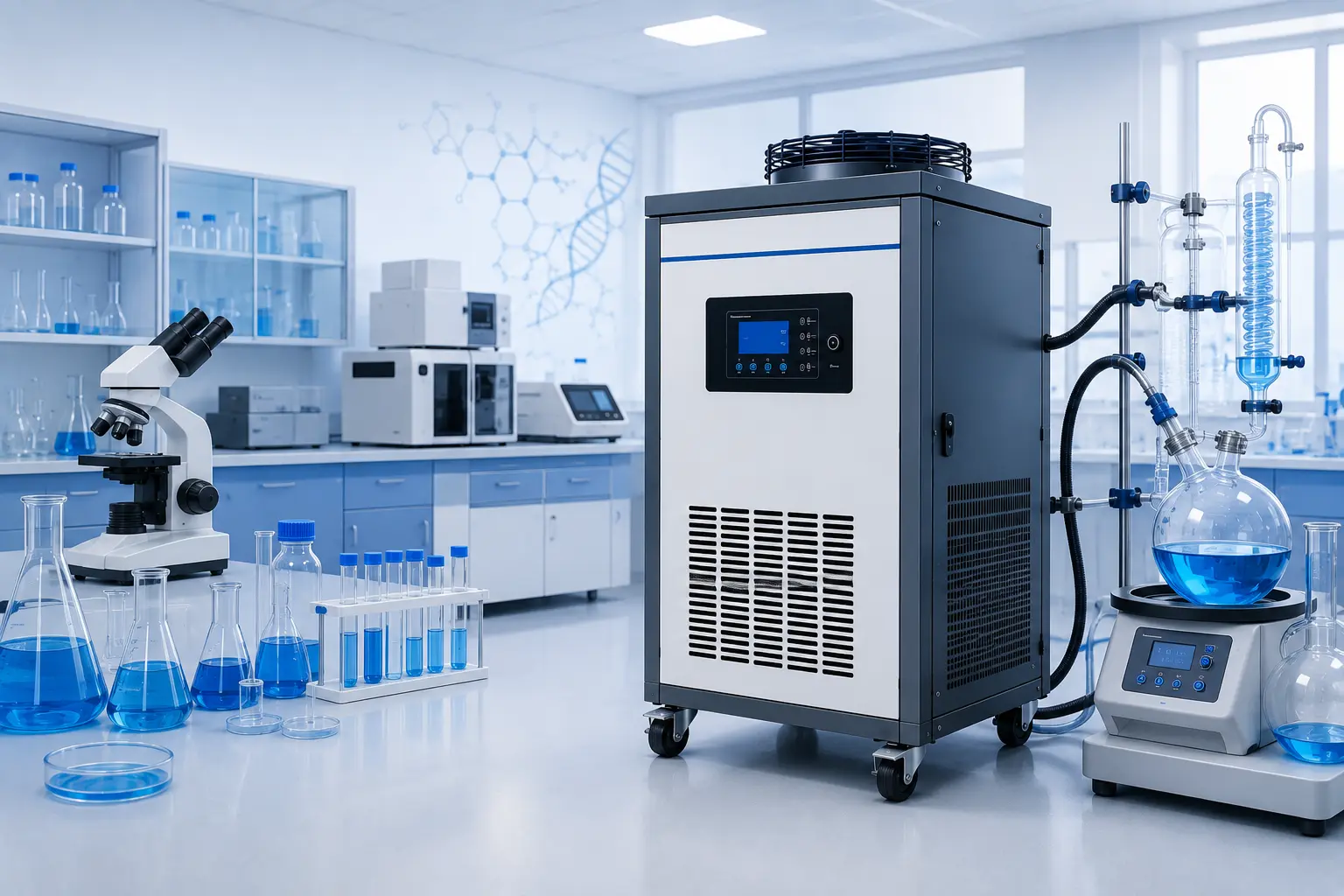
Pharmaceutical research and development demands uncompromising precision. In laboratories across Mumbai, Hyderabad, Ahmedabad, and Bengaluru, scientists working on active pharmaceutical ingredient (API) synthesis, biopharmaceutical production, and formulation development face a common challenge, managing thermal fluctuations that can destroy months of research in minutes.
A single degree of temperature deviation during a critical reaction stage can trigger unwanted side reactions, degrade sensitive biomolecules, or compromise product purity to levels that render entire batches worthless.
Laboratory chillers serve as the thermal backbone of modern pharmaceutical R&D, providing the precise, stable cooling required for complex chemical syntheses, biological processes, and analytical procedures.
The Indian pharmaceutical sector recorded a turnover of INR 4.72 lakh crore in FY25 (2024-25), and growing at approximately 10% annually, increasingly relies on advanced thermal management systems to meet stringent quality standards set by regulatory bodies including the Central Drugs Standard Control Organisation (CDSCO), US FDA, and European Medicines Agency.
1. Precision Temperature Control in API Synthesis and Exothermic Reactions
Laboratory chillers manage the heat of reaction in jacketed vessels during API synthesis, preventing product decomposition and unwanted side reactions by maintaining reaction temperatures within ±0.02°C of setpoint values. Chemical synthesis of active pharmaceutical ingredients frequently involves exothermic reactions where chemical bonds form and release substantial energy as heat.
Without adequate cooling, this thermal energy accumulates rapidly, raising reaction temperatures beyond optimal ranges and triggering decomposition pathways or secondary reactions that reduce yield and introduce impurities.
Jacketed glass reactors represent the standard equipment for pilot-scale API synthesis in pharmaceutical R&D facilities. These vessels feature a double-wall construction where the space between walls circulates temperature-controlled fluid supplied by external chillers.
During synthesis of temperature-sensitive APIs like certain beta-lactam antibiotics or steroids, maintaining reaction temperature within narrow ranges becomes critical to achieving acceptable yields and purity levels.
Critical thermal management requirements in API synthesis:
- Temperature stability: ±0.02°C prevents side reactions and product decomposition
- Cooling capacity: 3-5 kW typical for 50-litre jacketed reactors running moderately exothermic syntheses
- Response time: Rapid thermal transient management during reagent additions or highly exothermic phases
- Programmability: Automated temperature profile transitions supporting multi-step syntheses
Managing Thermal Runaway Risks in Multi-Step Syntheses
Multi-step API synthesis presents compounded thermal management challenges where each reaction stage requires different temperature conditions. Process chemists developing synthetic routes for complex molecules must consider cooling requirements at every step, particularly for reactions involving organometallic reagents, strong oxidising agents, or highly reactive intermediates.
Laboratory chillers equipped with programmable temperature profiles enable automated transitions between cooling setpoints, supporting sequential reaction stages without manual intervention that introduces delays and temperature excursions.
Beyond preventing runaway reactions, precise thermal control improves reproducibility between batches, a requirement for regulatory submissions where process consistency demonstrates manufacturing capability.
Data generated using well-controlled laboratory chillers during R&D provides the foundation for engineering specifications in commercial manufacturing facilities.
2. Thermal Stability in Biopharmaceutical Bioreactors and Fermentation
Cooling systems maintain metabolic rates in bioreactors producing protein-based therapeutics like insulin and monoclonal antibodies by controlling fermentation temperatures within ±0.1°C, preventing thermal stress that denatures enzymes and reduces product titres.
Biopharmaceutical production relies on living cells, typically bacteria, yeast, or mammalian cell lines engineered to produce therapeutic proteins. These biological systems exhibit extreme temperature sensitivity where even modest deviations from optimal growth conditions impair cellular metabolism, reduce protein expression, or trigger programmed cell death pathways.
Mammalian cell cultures producing monoclonal antibodies typically operate at 36-37°C, mimicking physiological conditions that support healthy cell growth and protein secretion. The metabolic heat load in a 100-litre bioreactor can exceed 2 kW, requiring continuous heat removal to prevent temperature drift that would compromise culture viability.
Key bioreactor thermal control parameters:
- Optimal temperature range: 36-37°C for mammalian cell cultures
- Stability requirement: ±0.1°C to prevent metabolic stress
- Heat load management: Dynamic cooling accommodating variable metabolic activity throughout fermentation cycles
- Enzyme protection: Maintaining optimal activity ranges spanning just 5-10°C between suboptimal and denaturing conditions
3. Enhancing Efficiency in Distillation and Solvent Recovery
Condenser cooling in rotary evaporators maximises solvent recovery rates exceeding 95 percent and protects against vacuum fluctuations by maintaining condenser temperatures 20-30°C below solvent boiling points.
Pharmaceutical laboratories consume substantial quantities of organic solvents during extraction, purification, and analytical procedures. Environmental regulations and cost considerations make solvent recovery economically attractive and environmentally responsible.
Rotary evaporators equipped with efficient condensers capture evaporated solvents that would otherwise vent to atmosphere or require disposal as hazardous waste.
The efficiency of solvent recovery depends critically on condenser temperature, insufficient cooling allows solvent vapours to bypass condensation and escape through vacuum lines, whilst excessive cooling risks freezing certain solvents or condensing atmospheric moisture that contaminates recovered material.
Economic Impact of Efficient Solvent Recovery
A pharmaceutical R&D laboratory consuming 500 litres of methanol monthly at approximately INR 200 per litre spends INR 100,000 annually on this single solvent. Recovering 90 percent of used solvent through properly chilled condensers reduces this expense by INR 90,000 per year, justifying chiller investment through direct cost savings independent of environmental benefits.
Optimal condenser temperatures for common pharmaceutical solvents:
- Methanol and ethanol: -10°C to -20°C for efficient recovery
- Dichloromethane and diethyl ether: -30°C for acceptable recovery rates
- Vacuum system protection: Preventing vapour breakthrough that corrodes pumps costing INR 2-3 lakh
4. Controlled Crystallization for Higher Product Purity
Stable cooling ramps provided by laboratory chillers allow formation of regular crystal structures during API purification, directly improving bioavailability by controlling particle size distribution and polymorphic form.
Crystallization represents a critical purification and isolation step in pharmaceutical manufacturing where dissolved APIs precipitate from solution as solid crystals. The quality of these crystals determines multiple product characteristics including purity, dissolution rate, stability, and bioavailability.
Crystal formation proceeds through nucleation and growth phases that respond differently to temperature conditions. Rapid cooling triggers simultaneous nucleation at many sites, producing numerous small crystals with irregular shapes and wide size distributions.
Controlled cooling at rates between 0.1°C to 1°C per minute promotes fewer nucleation sites and allows orderly crystal growth, yielding larger, more uniform crystals with superior filtration and drying characteristics.
Controlling Polymorphic Forms Through Thermal Management
Many pharmaceutical compounds exist in multiple solid-state forms called polymorphs, where identical molecular compositions arrange into different crystal lattices. These polymorphic forms often exhibit dramatically different properties: different melting points, solubilities, and bioavailabilities.
Temperature history during crystallization strongly influences which polymorph crystallizes from solution. By controlling cooling rates and terminal temperatures precisely, laboratory chillers enable researchers to produce desired polymorphic forms reproducibly, supporting regulatory submissions that demonstrate manufacturing control over critical quality attributes.
5. Safeguarding Integrity in Specialized Pharmaceutical Cold Storage
Laboratory chillers maintain constant temperatures for storage of temperature-sensitive biologics, vaccines, and reference standards, preserving potency that would degrade within hours at ambient conditions.
Pharmaceutical R&D facilities house valuable biological materials including cell lines, antibodies, enzymes, vaccines, and chemical reference standards that require continuous cold storage to maintain viability and activity.
Unlike household refrigerators or freezers that cycle compressors on and off, creating temperature fluctuations of 2-5°C, laboratory chillers maintain stable conditions within ±0.5°C through continuous modulated cooling. Vaccine storage exemplifies these stringent requirements. Many vaccines require storage between 2-8°C with deviations beyond this range causing irreversible potency loss.
Critical cold storage applications:
- Vaccine storage: 2-8°C with ±0.5°C stability prevents potency loss
- Biological reference standards: Temperature stability ensures analytical method accuracy
- Cell line preservation: Continuous cold storage maintains viability for research continuity
- Cost protection: Temperature excursions compromise materials worth lakhs of rupees
Technical Considerations for Selecting Pharma Chillers
Selecting appropriate cooling equipment for pharmaceutical R&D applications requires evaluating multiple technical and operational factors beyond simple cooling capacity. Laboratory managers must consider space constraints, heat dissipation requirements, noise levels, maintenance accessibility, and integration with existing laboratory infrastructure.
|
Parameter |
Air-Cooled Chillers |
Water-Cooled Chillers |
|
Laboratory Footprint |
Compact, self-contained units |
Requires separate cooling tower |
|
Heat Dissipation |
Releases heat into lab environment |
Transfers heat to building system |
|
Noise Level |
55-65 dB (moderate fan noise) |
40-50 dB (quieter operation) |
|
Installation Cost |
Lower (INR 2-4 lakh) |
Higher (INR 4-8 lakh) |
|
Operating Efficiency |
Lower in warm climates |
Higher efficiency year-round |
Air-cooled systems dominate smaller pharmaceutical laboratories where space limitations, budget constraints, or lack of building chilled water infrastructure make water-cooled systems impractical.
Water-cooled configurations suit larger pharmaceutical R&D facilities with central cooling tower systems or existing chilled water distribution networks.
Elevating Indian R&D Standards
Laboratory chillers constitute essential infrastructure supporting India’s pharmaceutical sector transformation from generic manufacturing toward innovation-driven research and biologics development.
The five applications examined throughout this article demonstrate how precision thermal management enables complex chemistry, protects sensitive biological materials, improves process efficiency, ensures product quality, and safeguards valuable research investments.
Hexon Instruments Private Limited, a Navi Mumbai-based chiller manufacturer in India, directly supports these critical pharmaceutical applications through the Smart Chillex Series designed specifically for demanding laboratory environments.
The Smart Chillex range addresses diverse pharmaceutical cooling requirements from compact benchtop units providing 1-2 kW cooling capacity for rotary evaporators to industrial-scale systems delivering 10-15 kW for pilot plant operations. All systems maintain temperature stability within ±0.1°C whilst featuring intuitive digital controls, comprehensive alarm systems, and robust construction suited to continuous operation in demanding research environments.
Pharmaceutical laboratories seeking reliable thermal management solutions that combine imported-equivalent performance with domestic cost-efficiency can explore Hexon’s comprehensive product portfolio at Hexon.
Our technical team provides consultative support for system selection, custom cooling solutions tailored to specific applications, and complete after-sales service ensuring long-term operational reliability.
Contact Hexon Instruments today to discover how precision cooling manufactured in India can support your pharmaceutical R&D objectives whilst optimising capital equipment investments.
Motorized XY stages solve this fundamental limitation by enabling automated scanning across large sample areas whilst maintaining micron-level positioning accuracy. These precision motion platforms integrate with optical microscopes to create automated imaging systems capable of capturing thousands of high-resolution images, stitching them into seamless panoramic views, and executing complex inspection protocols without human intervention. The technology transforms workflows across biomedical research, materials science, semiconductor manufacturing, and industrial quality control.
The Evolution of Automated Scanning in Biomedical Research
Motorized stages enable automated image stitching and large-area scanning essential for high-resolution panoramic imaging in pathology and pharmaceutical quality control by capturing hundreds of overlapping fields and computationally merging them into single continuous images spanning entire specimens. Digital pathology workflows depend critically on this capability, where whole slide imaging systems scan glass slides containing tissue biopsies at 20x or 40x magnification.
Traditional manual microscopy restricts pathologists to viewing small fields of view, typically 0.5-1.0mm diameter circles at diagnostic magnifications. A standard 15x15mm tissue section requires examining 225-900 separate fields to achieve complete coverage, consuming 30-60 minutes of continuous work. Human fatigue during extended sessions introduces inconsistency, whilst fragmented viewing makes spatial relationships difficult to appreciate.
Automated scanning with motorized stages completes the same task in 5-15 minutes whilst capturing every region with identical exposure, focus, and illumination conditions. The resulting panoramic images preserve spatial context, allowing pathologists to navigate seamlessly between overview and detail. Image analysis algorithms can then perform automated cell counting, measure staining intensity, or flag suspicious regions for expert review.
Pharmaceutical quality control laboratories employ similar workflows for filter paper inspection during sterility testing. Automated image stitching across entire filter surfaces reveals contamination patterns that spot-checking misses, improving detection sensitivity whilst reducing inspection time.
Precision Requirements for Microstructural Analysis in Metallurgy
Sub-micron resolution combined with positioning repeatability better than 2 micrometres allows consistent focus retention and positional accuracy when performing detailed grain structure analysis across large metallurgical specimen areas measuring 50-100mm in material science research. Metallurgical microscopy demands examination of polished and etched metal samples to reveal grain boundaries, phase distributions, and defect structures that determine mechanical properties.
Material scientists studying failure mechanisms in aerospace components need to correlate microstructural features with stress concentrations and crack initiation sites. This requires scanning large areas around failure locations whilst maintaining high magnification necessary to resolve grain-scale details. Manual stage positioning introduces coordinate uncertainties of 10-50 micrometres, making it impossible to return precisely to specific features for follow-up examination.
Motorized stages with digital coordinate systems enable researchers to record exact positions of features of interest, return to those locations days or weeks later with micron-level accuracy, and build comprehensive maps correlating microstructure with mechanical testing results. The ±5µm mechanical accuracy ensures that features identified in initial scans remain accurately positioned through subsequent examination cycles.
Large metallurgical samples often exceed 50x50mm in area. Motorized stages with 300x300mm travel range accommodate these specimens whilst maintaining positioning precision across the full working envelope. Vibration-free operation prevents image degradation during automated scanning, preserving image quality necessary for quantitative metallography measurements.
Semiconductor Inspection: Automating 300mm Wafer Analysis
Low defect tolerance in semiconductor manufacturing demands automated optical inspection (AOI) systems capable of detecting line breaks, shorts, and particle contamination across 300mm wafers, where motorized stages enable systematic scanning with 0.6 µm resolution to identify defects measuring just a few micrometres. Modern semiconductor fabrication operates at technology nodes below 10 nanometres, where microscopic defects cause device failures and yield losses.
Semiconductor manufacturers inspect wafers at multiple production stages: after photolithography to verify pattern transfer, following etching to confirm feature dimensions, and post-cleaning to detect particle contamination. Automated optical inspection systems integrate high-resolution microscopes with precision motorized stages to execute programmable scan patterns that systematically image entire wafer surfaces.
The stages position samples with repeatability measured in hundreds of nanometres, ensuring multiple inspection passes align accurately for before-after comparisons. Real-time image analysis algorithms running during scanning identify anomalies including line breaks, shorts, and particle contamination.
The economic impact is substantial. A single 300mm wafer may contain several hundred die valued at INR 5,000-50,000 each depending on device complexity. Early defect detection enables process corrections before entire batches become scrap, protecting investments potentially exceeding INR 50 lakh per wafer lot.
Beyond Imaging: Solar Cell Analysis and PCB Quality Control
Specialized applications including solar cell finger interruption detection and printed circuit board copper bridging inspection utilise high-travel motorized stages spanning 300x300mm to accommodate large samples whilst maintaining micron-level accuracy for defect identification. These industrial quality control applications demand different performance characteristics, prioritising large working envelopes and rapid scanning.
Solar cell manufacturing produces panels measuring 156x156mm or larger, where metallic grid fingers collect photogenerated current. Finger interruptions, breaks in these fine metal lines, reduce cell efficiency and power output. Automated inspection systems scan entire cell surfaces using motorized stages, employing image analysis to identify discontinuities requiring rework or rejection.
Printed circuit board inspection benefits from automated scanning, where solder joint quality, component placement accuracy, and copper trace integrity determine assembly reliability. Motorized stages enable systematic inspection of complex boards containing thousands of solder joints, identifying defects including insufficient solder, bridging between adjacent pads, and copper trace breaks.
Technical Checklist: Selecting a Motion Platform for High-Throughput Labs
Laboratories evaluating motion platforms must consider multiple technical and operational factors determining long-term performance and integration success.
|
Parameter |
Manual Stages |
Motorized Stages |
|
Positioning Speed |
5-20 mm/s |
1-750 mm/s |
|
Repeatability |
10-50 µm |
<0.5-2 µm |
|
Scan Coverage |
Limited by operator |
Complete automated coverage |
|
Software Integration |
None |
Full automation, data logging |
|
Throughput |
1-5 samples/hour |
10-60 samples/hour |
Key selection criteria include travel range matching maximum sample dimensions, positioning resolution appropriate to imaging magnification, and load capacity accommodating sample fixtures. Vibration-free operation becomes critical at magnifications above 20x where mechanical resonances degrade image quality.
Elevating Indian Scientific Engineering Standards
Motorized XY stages represent essential infrastructure supporting India’s advancement in biomedical research, semiconductor manufacturing, and precision industrial quality control.
As a trusted motorized stage manufacturer in India, Hexon delivers systems achieving 0.6 µm resolution with ±5µm mechanical accuracy across travel ranges up to 300x300mm, matching international performance standards whilst providing cost advantages through domestic manufacturing.
Hexon’s engineering capabilities address the complete spectrum of automated imaging requirements: compact benchtop systems for routine microscopy, industrial AOI platforms for semiconductor inspection, and custom configurations for specialised research applications. The noiseless motion control eliminates vibration artifacts, whilst intuitive software interfaces simplify workflow development.