Application of Single Pulse EDM

A Single Pulse Electrical Discharge Machine (EDM) is a specialized setup used to study the fundamentals of the Electrical Discharge Machining process by generating one controlled spark (pulse) between the tool and the workpiece. It’s mainly used in research, teaching, and process analysis rather than full-scale manufacturing.

Single pulse EDM produces just one spark discharge instead of a continuous series of sparks (as in conventional EDM). This allows precise observation of:

  1. Material removal mechanism
  2. Crater formation
  3. Heat-affected zone

It works on the same principle as EDM:

  1. Two electrodes (tool and workpiece) are submerged in a dielectric fluid.
  2. A voltage is applied across a small gap.
  3. When the voltage exceeds the breakdown strength, a spark discharge occurs.
  4. This spark generates intense heat (8000–12000°C), melting and vaporizing a small portion of material.

Single pulse EDM is a research-oriented version of Electrical Discharge Machining that isolates a single spark event. By studying one discharge at a time, engineers can better understand and improve the efficiency, accuracy, and surface quality of EDM processes used in industries like aerospace, tooling, and die-making.

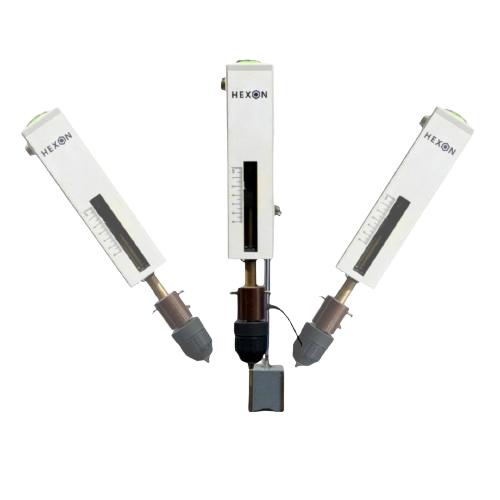
Hexon Single pulse EDM system comprises of Z linear axis, DC power supply, Controller with HMI Interface, Tool holder, tool and workpiece. The full system is shown in Fig. 1. The DC power supply has rating of 0-100V, 0-10A.  The working of the system is as follows:

  1. After setting the tool and the workpiece in the tank, the first page of the HMI has zero setting button. Before pressing the zero setting button, set 5V to the DC power supply. When this button is pressed, The tool will move towards the workpiece in Z direction and when the tool will come in contact with the workpiece, the tool stops and move in the upwards direction to the predefined distance from the workpiece.

Fig. 1 Single pulse EDM system


Fig. 2 HMI Interface

  1. After zero setting is completed, a new page appears to input the parameters. A capacitance of 0.47uF is fixed inside the controller box. But the user can connect other capacitors in parallel to change the capacitance. The voltage can be changed in the DC power supply. The user can defined the % discharge of the total energy of the capacitor.


Fig. 3 Controller with HMI Interface

  1. First set the required voltage in DC power supply for the single spark experiment. Once all the input parameters are set, press start button (green color). After pressing the start button, the tool moves towards the workpiece and a single spark flash and the tool stops at that particular location to provide the spark gap. On finishing the experiments, the value of discharge gap and discharge energy automatically calculated and appears in the HMI page.

The above steps can be repeated for different sets of parameters.

Key Applications of Single Pulse EDM

01

Crater Formation Analysis

Study the size, shape, and depth of craters produced by a single spark.
Understand material removal mechanisms.

02

EDM Process
Research

Investigate the effects of pulse current, pulse duration, and voltage on machining performance.
Develop mathematical and simulation models for EDM.

03

Material Removal Rate (MRR) Studies

Evaluate how different materials respond to electrical discharges.
Compare machining characteristics of various alloys and conductive materials.

04

Tool Wear Investigation

Analyze electrode wear caused by a single discharge.
Optimize electrode materials and geometries.

05

Heat-Affected Zone (HAZ) Analysis

Study thermal effects on the workpiece.
Examine recast layer formation, micro-cracks, and metallurgical changes.

06

Surface Integrity Evaluation

Measure surface roughness and microstructural changes resulting from a single spark.
Improve EDM surface quality.

07

Dielectric Fluid Research

Investigate the influence of different dielectric fluids on spark behavior and machining efficiency.

08

Development of Advanced EDM Systems

Used in micro-EDM, nano-EDM, and high-precision EDM research.
Helps optimize pulse generators and control systems.

Compliance & Certifications

Built To Meet Regulatory And Quality Standards

Meets CFR 21 Part 11 Requirements For Electronic Records And Audit Trails

Ensures Data Integrity For Pharmaceutical R&D, Regulated Labs, And Quality-Controlled Production

Time-Stamps And Logs Every Parameter, Error Event, And Status Change

Complete Audit Trails Extractable For Regulatory Submission
Any Kind Of Query Please Contact With Us !

Our prestigious Clients

Request Technical Demo

Enquiry Now