
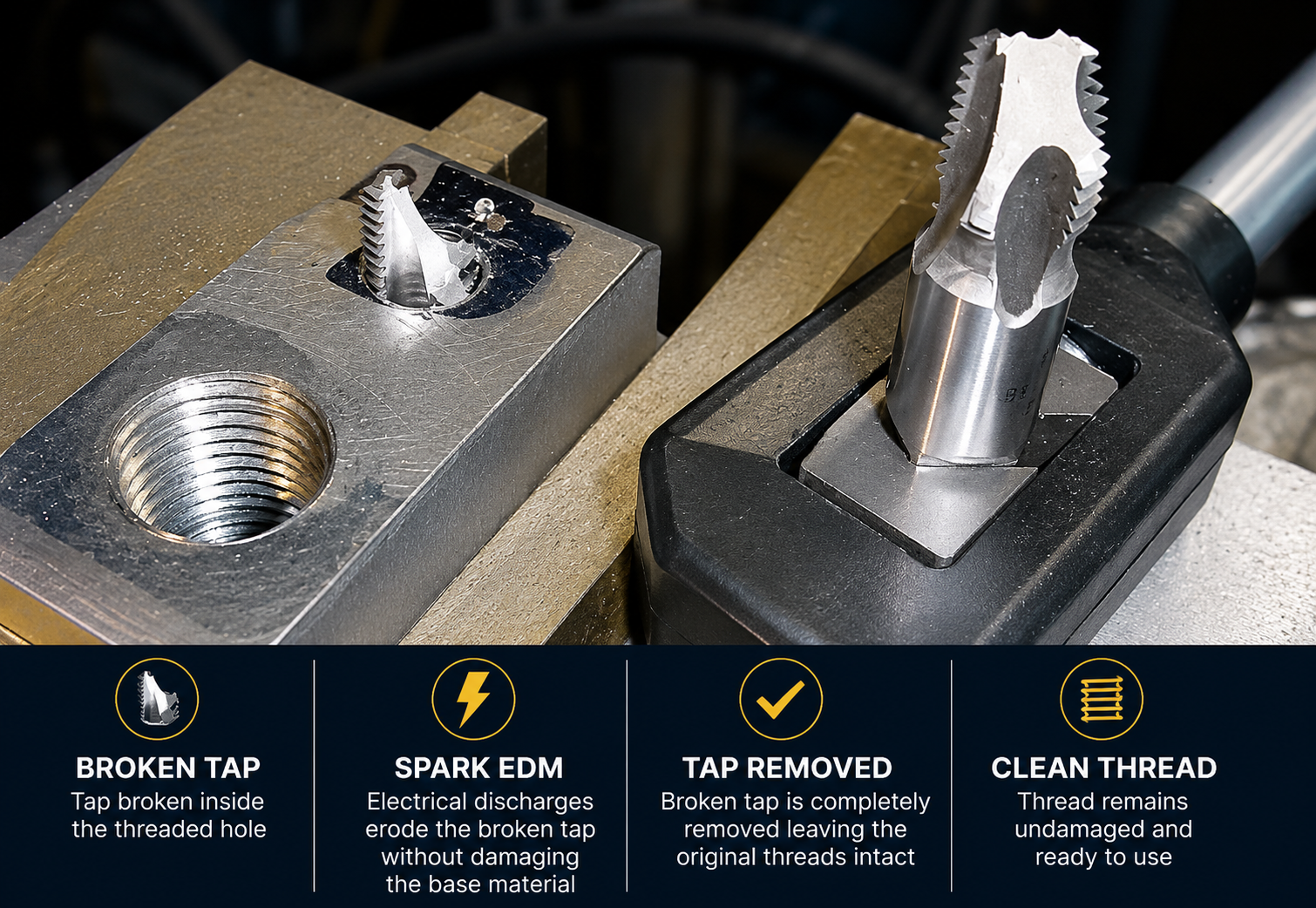
It happens fast. One moment the tapping cycle is running normally, and the next the machine has stopped and there’s a broken tap flush inside a threaded bore. For low-cost blanks, scrapping the part is a simple decision. For a precision aerospace bracket, a medical implant housing, or a complex mold tool that took 40 hours to machine, scrapping is not a viable option.
Removing a broken tap without damaging the surrounding threads or the workpiece surface is one of the most technically demanding recovery operations in a machine shop. The method you choose depends on how deep the tap broke, what the workpiece material is, and how much thread integrity needs to be preserved. This guide covers the available methods honestly, and explains why Electrical Discharge Machining (EDM) is the most reliable option for high-value CNC parts.
Why Taps Break in CNC Machining
Understanding why taps break helps prevent recurrence. The most common causes in CNC environments are:
- Insufficient chip clearance: When chips from the tapping operation pack into the flutes and can’t escape, torque builds until the tap fractures. This happens more often in deep holes without peck tapping cycles.
- Incorrect feed rate or speed: Tapping at the wrong surface speed for the material causes excessive torque. Aluminium and copper alloys need different parameters than stainless steel or titanium.
- Tap reaching the bottom of a blind hole: If the programmed depth exceeds the usable thread depth, the tap contacts the bottom under full torque. This is the single fastest way to snap a tap.
- Tool wear: A worn tap requires higher cutting forces to produce the same thread. Worn tools are disproportionately likely to break at the start of a new hole.
Once the tap breaks, the immediate priority is choosing the right removal strategy before attempting anything.
Method 1: Tap Extractors (for Accessible, Partially Protruding Taps)
Tap extractors work by inserting hardened fingers or flutes into the grooves of the broken tap and applying reverse torque. They’re the first tool most machinists reach for because they’re fast and inexpensive.
The honest limitation: tap extractors only work reliably when the broken tap has some protrusion above the workpiece surface and when it hasn’t been stressed to the point of binding in the thread. If the tap broke at or below the surface, extraction fingers have nothing to grip. If the tap seized in the thread under high torque, a tap extractor is likely to apply more torque than the part threads can safely withstand.
For small taps (M6 and below), extractor fingers are often too fragile to generate meaningful torque without breaking themselves. Use this method when the break was clean and part of the tap still projects above the surface.
Method 2: Chemical Dissolution (for Specific Material Combinations)
Alum solution (potassium aluminium sulphate dissolved in hot water) can chemically dissolve high-speed steel (HSS) taps while leaving aluminium workpieces largely unaffected. The part is submerged in the solution, which attacks the tap material selectively over 12 to 24 hours.
This method requires the right material pairing: it works for HSS taps in aluminium. It does not work for carbide taps, or for workpieces made of steel, stainless, or titanium, because the solution would attack the workpiece as aggressively as the tap. Thread quality after chemical removal is generally good since no mechanical force is applied.
Method 3: Drilling Out (When Thread Repair Is Acceptable)
Drilling out a broken tap involves using a carbide drill to bore through the tap material. When the tap is softer than the workpiece (unusual) or the tap is made of HSS and the workpiece is hardened steel, carbide can cut through the tap.
The significant risk is that a carbide drill large enough to remove the tap core will also damage or remove thread material in the bore. The resulting hole typically needs to be re-tapped at the next size up or fitted with a thread insert such as a Helicoil. This is acceptable for structural fastener holes but not for precision fit locations where the thread diameter is fixed.
Method 4: EDM Tap Removal — The Best Method for Precision CNC Parts
Electrical Discharge Machining (EDM) is the most reliable method for removing broken taps from high-value CNC components. EDM uses controlled electrical discharges to erode the tap material precisely, without applying any mechanical force to the workpiece.
The process works as follows: a shaped electrode (typically brass or copper, matched to the tap’s cross-section) is positioned over the broken tap. The machine delivers high-frequency electrical pulses that erode the tap material away progressively. The process continues until the tap core is removed. Remaining tap fragments, which are no longer bonded together, can then be flushed or picked out of the thread grooves.
The key advantage is thread preservation. Because EDM erodes by electrical discharge rather than mechanical cutting, the surrounding thread material in the workpiece is unaffected. A properly set up EDM removal on an M8 tap in stainless steel leaves the original threads intact and ready for a new fastener.
Hexon Instruments’ Portable EDM (available as the EDM HX 100 and the Portable EDM for Broken Tap Removal) is built specifically for this task. It handles tap sizes from M3 to M48 depending on configuration, and its portable design means it can be brought to the workpiece rather than moving a large, heavy part to a fixed EDM machine. For in-situ broken tap removal on large molds, fixtures, or mounted machine components, this portability is a genuine operational advantage.
Choosing the Right Method for Your Situation
|
Situation |
Recommended Method |
|---|---|
|
Tap protruding above surface, clean break |
Tap extractor |
|
HSS tap in aluminium workpiece |
Chemical (alum) dissolution |
|
Thread diameter not critical, repair acceptable |
Drill out and re-tap or insert |
|
Precision thread must be preserved, any material |
EDM removal |
|
Part too large to move to fixed EDM |
Hexon Portable EDM |
Preventing Future Tap Breakage
Recovery is costly. Prevention is far cheaper. In CNC tapping, the most effective preventive measures are:
- Using spiral flute (gun) taps for blind holes to push chips up and out rather than packing them in
- Programming peck tapping cycles for holes deeper than 2x the tap diameter
- Verifying programmed depth leaves at least 1.5x the tap diameter of clearance before the hole bottom
- Replacing taps after a defined number of holes based on material and tap size, not waiting for visual wear
A broken tap in a precision CNC part is not automatically a scrap situation. The right method, applied correctly, can recover the part and preserve the thread. For straightforward cases with accessible tap remnants, a tap extractor is fast and sufficient. For high-value precision components where the thread must survive intact, EDM removal is the method that works regardless of tap material, workpiece hardness, or tap depth.
Hexon Instruments’ Portable EDM brings that precision recovery capability directly to your workshop, without the cost or footprint of a full EDM machine installation.
FAQ’s
Q1: Can EDM remove a carbide tap as well as an HSS tap?
Yes, EDM erodes by electrical discharge and works on both HSS and carbide tap materials effectively.
Q2: Does EDM tap removal damage the existing threads in the workpiece?
No, EDM removes only the tap material; surrounding workpiece threads remain intact and usable.
Q3: What tap sizes can the Hexon Portable EDM handle?
The Hexon Portable EDM handles broken taps from M3 to M48 depending on the configuration used.