
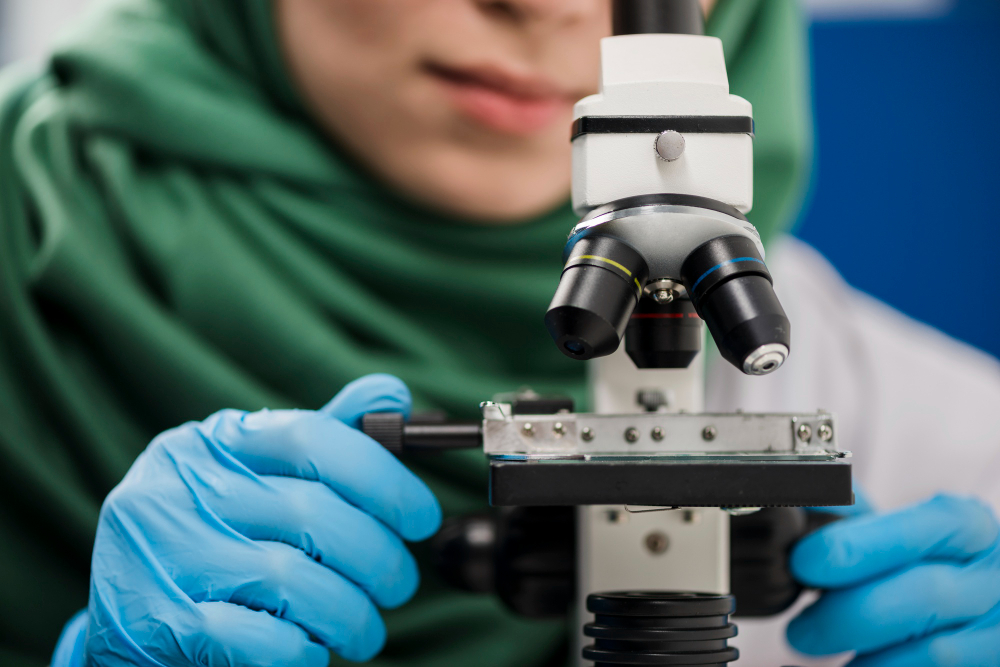
Hexon Instruments offers an advanced clinker analysis solution combining the precision of the Olympus microscope platform with Hexon’s Motorized XY Stage and image analysis software, enabling cement manufacturers to perform detailed, repeatable, and efficient ASTM C1356 clinker investigations.
Improving Cement Quality Through Advanced Clinker Microscopy
Cement clinker is the most critical intermediate product in cement manufacturing. The mineral composition, crystal structure, and phase distribution within clinker directly influence cement strength, setting time, grindability, and overall product quality. Microscopic examination of clinker remains one of the most effective methods for evaluating kiln performance, raw mix quality, and process optimization.
Why Clinker Microscopy Matters
Chemical analysis alone cannot reveal the complete story of clinker formation. Microscopic analysis gives process engineers direct visual insight into mineralogy, crystal morphology, burnability, and phase composition, letting them identify production issues before they affect cement performance.
Chemical analysis alone cannot reveal the complete story of clinker formation. Microscopic analysis provides direct insight into:
- Clinker mineralogy
- Crystal morphology
- Burnability of raw mix
- Kiln operating conditions
- Free lime distribution
- Phase composition
- Cooling efficiency
- Quality consistency
By examining clinker under a microscope, process engineers can identify production issues before they impact cement performance.
The Hexon Clinker Analysis Solution
The Hexon solution pairs an Olympus microscope platform delivering high-resolution brightfield and polarized imaging with a Motorized XY Stage that automates navigation across large clinker sections.
Olympus Microscope Platform
The Olympus microscope provides high-resolution imaging and superior optical performance for clinker analysis.
Key Features:
- Brightfield microscopy
- Polarized light observation
- High-quality optics
- Digital image acquisition
- Multiple magnification options
- Excellent contrast for etched clinker samples
The microscope allows clear visualization of clinker phases and microstructural features essential for quality assessment.
Hexon Motorized XY Stage
Traditional clinker analysis often requires manual movement across multiple sample areas. Hexon’s Motorized XY Stage automates this process and improves analytical efficiency.
Benefits include:
- Automated sample navigation
- Large area scanning
- Precise positioning
- Repeatable inspections
- Automated image stitching
- Reduced operator fatigue
- Improved statistical sampling
The motorized stage enables systematic examination of clinker sections, ensuring representative analysis of the entire sample.
Clinker Sample Preparation
Accurate clinker analysis begins with a four-step preparation sequence: sampling representative nodules, mounting them in epoxy resin, grinding and polishing to a mirror-like surface, and chemical etching to reveal phase boundaries.
Step 1: Sampling
Representative clinker nodules are collected from the production line.
Step 2: Mounting
Clinker particles are embedded in epoxy resin.
Step 3: Grinding and Polishing
The mounted sample is ground and polished to obtain a flat, mirror-like surface.
Step 4: Chemical Etching
Special etchants are applied to reveal clinker phases and crystal boundaries. The prepared sample is then ready for microscopic examination.
Key Phases Evaluated During Clinker Analysis
Clinker microscopy evaluates four mineral phases, alite, belite, aluminate, and ferrite, alongside free lime content, each offering distinct evidence about burning conditions and expected cement performance.
Alite (C3S)
Alite is the primary phase responsible for early cement strength.
Microscopic observations include:
- Crystal size
- Crystal shape
- Distribution
- Growth patterns
Large, well-formed alite crystals generally indicate proper kiln conditions.
Belite (C2S)
Belite contributes to long-term strength development.
Analysis focuses on:
- Crystal morphology
- Distribution
- Transformation characteristics
Excessive belite may indicate insufficient burning temperatures.
Aluminate Phase (C3A)
The aluminate phase affects setting behavior and sulfate demand.
Microscopy helps determine:
- Distribution
- Homogeneity
- Phase proportions
Ferrite Phase (C4AF)
Ferrite contributes to clinker melt formation and influences kiln performance.
Microscopic examination evaluates:
- Crystal structure
- Phase connectivity
- Distribution patterns
Free Lime Analysis
Free lime is a critical quality indicator. High free lime levels may suggest:
- Incomplete clinker burning
- Poor raw mix homogenization
- Insufficient kiln residence time
Microscopy allows direct visualization of free lime particles and their distribution within the clinker matrix.
Kiln Performance Assessment
Specific microscopic observations, such as crystal size, belite content, and matrix texture, translate directly into diagnostic conclusions about kiln burning and cooling conditions.
Microscopic clinker evaluation provides valuable feedback on kiln operation. Indicators include:
Observation | Possible Interpretation |
Large Alite Crystals | Slow cooling |
Small Alite Crystals | Rapid cooling |
High Belite Content | Under-burning |
Excess Free Lime | Incomplete reaction |
Uneven Phase Distribution | Poor raw mix homogenization |
Glassy Matrix | Excessive liquid phase |
Such observations help process engineers optimize kiln efficiency and product quality.
Automated Image Acquisition and Analysis
Combining the Olympus microscope with the Hexon Motorized Stage lets laboratories automatically scan large clinker sections, stitch multiple fields of view, and archive data for quantitative phase comparison over time.
By combining the Olympus microscope with the Hexon Motorized Stage, laboratories can:
- Scan large clinker sections automatically
- Capture multiple fields of view
- Generate stitched images
- Perform quantitative phase analysis
- Archive inspection data
- Compare clinker quality over time
The automated workflow significantly reduces manual effort while improving consistency and traceability.
Benefits for Cement Manufacturers
The Hexon solution delivers five measurable benefits: earlier detection of process variation, deeper kiln optimization insight, faster root cause analysis, higher laboratory throughput, and standardized reporting across operators.
- Improved Quality Control: Detect process variations before they affect finished cement.
- Better Kiln Optimization: Gain deeper insight into burning conditions and clinker formation.
- Faster Root Cause Analysis: Identify sources of quality issues quickly and accurately.
- Increased Laboratory Efficiency: Automated stage movement and image acquisition reduce inspection time.
- Consistent Reporting: Standardized workflows improve repeatability across operators and facilities.
Applications
The Hexon Clinker Analysis Solution is suitable for:
- Cement Manufacturing Plants
- Cement Research Laboratories
- Quality Control Laboratories
- Process Optimization Studies
- Alternative Fuel Evaluations
- Raw Mix Development Programs
- Academic and Industrial Research Centers
Microscopic clinker analysis remains one of the most powerful tools available to cement manufacturers for understanding and optimizing production processes. By combining the advanced imaging capabilities of Olympus microscopy with the automation and precision of the Hexon Motorized XY Stage, laboratories can achieve faster, more reliable, and more comprehensive clinker characterization.
Hexon Instruments delivers a modern clinker analysis platform that helps cement producers improve product quality, optimize kiln performance, and maintain consistent manufacturing excellence.
FAQs
Q1. What four mineral phases are evaluated in clinker microscopy?
Analysts evaluate alite (C3S), belite (C2S), the aluminate phase (C3A), and the ferrite phase (C4AF), alongside free lime content, to assess clinker quality and kiln performance.
Q2. How does crystal size indicate kiln cooling rate?
Large alite crystals generally indicate slow cooling, while small alite crystals indicate rapid cooling, making crystal size a direct microscopic signal of cooling conditions.
Q3. What does high free lime content suggest about the clinkering process?
Excess free lime may suggest incomplete clinker burning, poor raw mix homogenization, or insufficient kiln residence time.
Q4. How is a clinker sample prepared before microscopic analysis?
Representative clinker nodules are sampled, mounted in epoxy resin, ground and polished to a mirror-like surface, and then chemically etched to reveal clinker phases and crystal boundaries.