
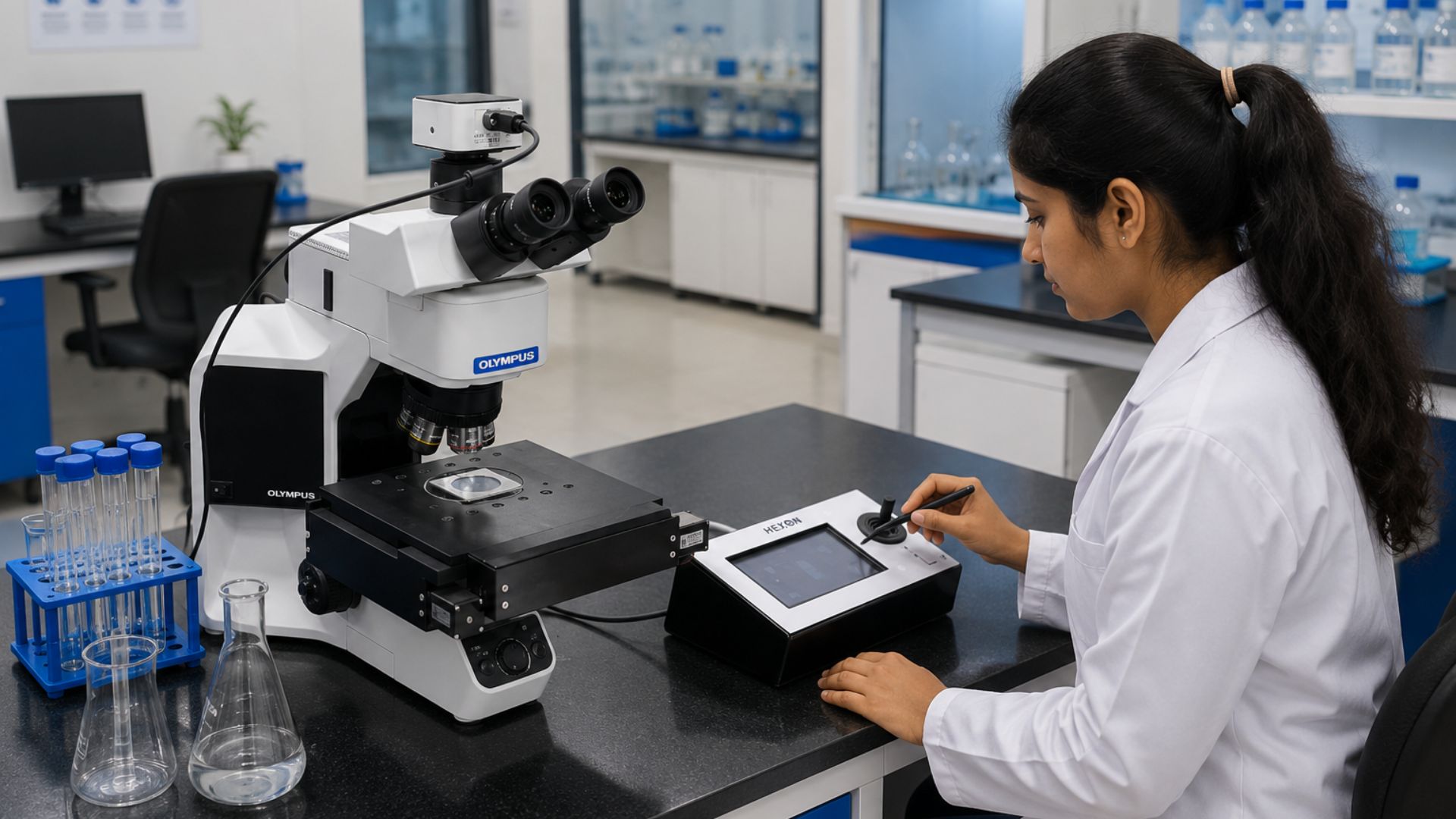
Manual sample positioning on a microscope sounds simple. Move the stage, focus, capture, repeat. But in a real testing environment, that process runs for hours, across hundreds of sample points, demanding sub-micron repeatability every single time. That’s where human hands fall short and motorized stages take over. Whether you’re running hardness profiles, surface scans, or fiber analysis, motorized XY and Z stages can turn a tedious manual workflow into a fully automated, highly repeatable process that works even when the operator steps away.
What Is a Motorized Stage and How Does It Work in Material Testing?
A motorized stage is a precision-driven platform that replaces manual sample movement on a microscope or testing instrument. It uses servo motors or stepper motors to move the sample along the X, Y, and sometimes Z axes with programmable accuracy, often reaching resolutions in the micron and sub-micron range. In material testing, the stage connects to a motion controller and software that defines a scanning path, then moves through it automatically, capturing images or measurements at each defined coordinate.
This is far more consistent than hand-operated knobs, where even a trained technician introduces drift and fatigue over long sessions. Hexon Instruments’ Motorized XY Stage and Motorized Z Drive are designed specifically for integration into existing microscope setups, making automation accessible without replacing your current optical infrastructure.
How a Motorized Stage Controller Works
The motion controller is the brain of the system. It receives a coordinate list or grid definition from your acquisition software, converts it into step commands for the stage motors, and confirms each position via encoder feedback before triggering the camera or measurement instrument. This closed-loop architecture is what delivers the sub-micron repeatability that manual knobs cannot match. Controllers from Hexon are compatible with standard lab command sets, so existing software workflows carry over without reprogramming.
Why Manual Stages Create Bottlenecks in High-Throughput Material Testing
Manual positioning is the most common bottleneck in lab throughput. When a technician must individually position, focus, and capture each region of interest, the process slows to the pace of human attention. A hardness testing routine requiring 50 indentations across a cross-sectioned sample takes roughly 2 to 3 minutes per location manually, over 2.5 hours for a single sample. With a motorized stage running a pre-programmed grid, the same routine finishes in 20 to 30 minutes with zero positional drift between measurements.
The repeatability difference is equally striking. Motorized stages with encoder feedback maintain positional accuracy within ±1 to ±5 microns across the full travel range. Manual stages, even with fine adjustment knobs, regularly exceed ±20 microns under real-world lab conditions.
He Hidden Cost of Manual Positioning Errors
Every positioning error in a hardness test, grain measurement, or surface scan means either a repeat measurement or a compromised data point that skews the result. In a batch environment where 20 samples run daily, even a 10% re-run rate from positioning inconsistency adds 2 hours of lost capacity per day. Motorized stages eliminate that category of error entirely: the position is confirmed by the encoder before measurement, not estimated by the operator’s hand.
Key Applications Where Motorized Stages Deliver the Biggest Gains
Motorized stages are not a single-use tool. Across materials science, electronics, and metallurgy, they enable workflows that simply aren’t practical by hand:
- Filter paper inspection for cleanliness testing of components in an automobile and contamination in the injection sample.
- Stitching of the semiconductor image and positioning as per the coordinate for automated image analysis.
Each of these applications shares one requirement: consistent, reliable positioning that doesn’t drift or tire.
Motorized Stages in Semiconductor and Electronics Testing
Beyond traditional materials labs, motorized XY stages are widely used in electronics and semiconductor inspection. Automated optical inspection of PCB surfaces, solder joint characterisation, and wafer defect mapping all depend on precise, repeatable stage movement across areas that no human hand could navigate consistently at speed. The Hexon Motorized XY Stage is suitable for these applications, offering the travel range and positional resolution that electronics testing demands.
How Motorized Z Stages Improve Focus Accuracy Across Uneven Samples
The Z axis is often overlooked but critical. When a sample surface isn’t perfectly flat, and few real-world samples are, the focal plane shifts as the XY stage moves across it. Without motorized Z control, the operator must manually refocus at each position, adding time and introducing inconsistency.
Motorized Z drives solve this by enabling auto-focus routines. As the stage steps through its XY grid, the Z axis adjusts to maintain the optimal focal distance based on contrast or intensity feedback from the camera. Hexon Instruments’ Z Drive integrates with standard microscope bodies and allows fine-step resolution that keeps images sharp across the full scan path.
Which Sample Types Benefit Most from Z-Axis Automation
Z-axis automation delivers the biggest gain on samples with inherent surface variation:
- Metallographic cross-sections where polishing introduces subtle height variation across the field
- Polymer film samples that bow slightly under mounting pressure
- Corroded or textured surfaces where the imaging plane changes continuously as the XY stage traverses
For flat, well-mounted samples on a precision stage, Z correction may be minimal. For anything with topography, it’s the difference between sharp data and blurred measurements.
Integrating Motorized Stages with Existing Lab Software
A common concern when moving to motorized stages is software compatibility. Most modern labs already use image acquisition software, and adding a stage should not mean replacing that system. Hexon motorized stages are compatible with industry-standard control interfaces, allowing integration with software environments commonly used in materials and life science imaging.
The motion controller accepts programmed coordinate lists, grid definitions, and point arrays, so your existing test protocols translate directly to automated stage commands. For labs running custom measurement routines, the stage can also operate through standard command sets that most lab automation environments support, meaning your technicians keep their familiar software while gaining the speed and precision of automated motion.
Compatibility with Common Measurement Software
Hexon motorized stages work with standard motion control command sets compatible with most image acquisition and metrology software platforms used in Indian research and industrial labs. This includes compatibility with coordinate input formats used by hardness testing software, surface profiling systems, and microscopy automation suites. No proprietary lock-in: if your software can send stage commands, the Hexon stage can receive and execute them.
The Real Return on Investment for Motorized Stages in a Materials Lab
The cost of a motorized stage system pays back through three measurable gains: time saved per sample, reduction in repeat measurements caused by positioning error, and the ability to run unattended overnight scans. A typical materials testing lab processing 15 to 20 samples per day with manual stages can increase throughput to 40 to 60 samples per day after automating positioning. Unattended overnight runs add further capacity without adding headcount.
The reduction in operator fatigue also lowers the rate of measurement errors that require re-runs. When you factor in the cost of scrapped parts due to incomplete or inaccurate testing, the return on a motorized stage becomes compelling within the first year of operation for most mid-to-high volume labs.
Motorized stages are not a luxury for well-funded research institutions. They’re a practical upgrade for any materials testing lab where throughput, repeatability, and data quality matter. Whether you’re mapping hardness across a turbine blade cross-section or scanning composite panels for void content, automating your stage eliminates the most time-consuming and error-prone step in your measurement workflow.
Hexon Instruments offers motorized XY stages and Z drives designed for real lab conditions, with the compatibility and build quality that material testing demands. If your current setup relies on manual positioning, the upgrade is straightforward and the gains are immediate.
FAQ’s
Can a motorized stage be added to an existing manual microscope?
Yes, Hexon motorized stages are designed as drop-in upgrades for most standard manual microscope bodies.
What positional accuracy can I expect from a motorized XY stage?
Hexon motorized stages typically achieve repeatability within ±1 to ±5 microns across the full travel range.
Is special software required to run automated scanning routines?
No, Hexon stages work with standard lab motion control interfaces and most common image acquisition software.