
Temperature drift in a running experiment rarely announces itself. The rotary evaporator slows down, the reaction yield drops, or the analytical instrument reading drifts by a fraction, and only later does the team realise the chiller had been holding 2°C off target for the past hour. A chiller with a dial and an analogue gauge can’t tell you that’s happening. A chiller with digital controls can, and it will correct itself before the deviation becomes a problem.
Switching to a digitally controlled chiller is not just about convenience. It’s about process reliability, data defensibility, and reducing the hidden cost of temperature-related experiment failures.
What Makes a Digitally Controlled Chiller Different?
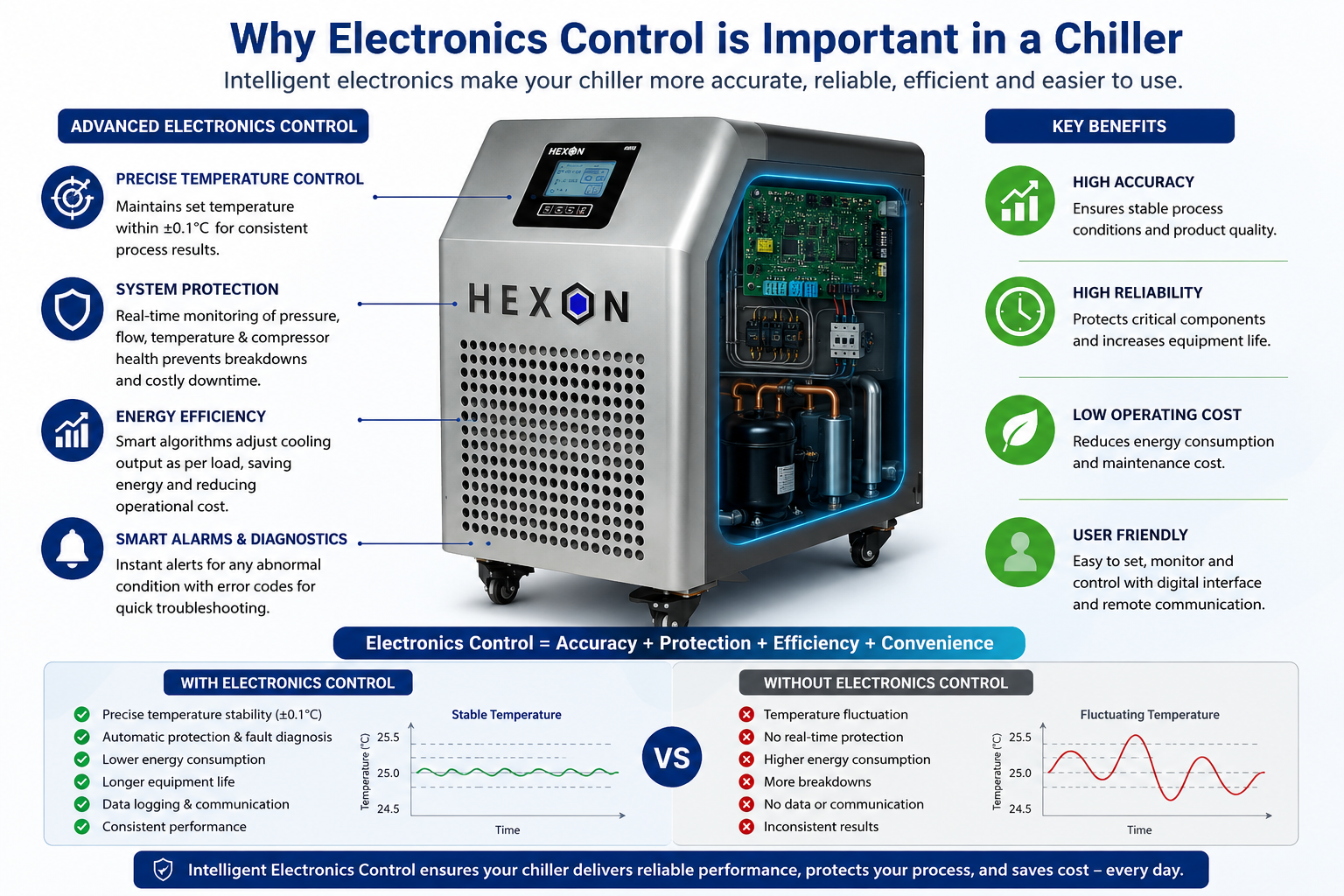
A chiller with digital controls replaces mechanical dials and analogue indicators with a programmable electronic control system. At its core, the digital controller reads temperature from a precision sensor, compares the reading against your setpoint, and adjusts compressor and pump output in real time to eliminate the gap.
The visible difference is the display: you see an exact numerical readout rather than a needle on a dial. The operational difference is far larger. Digital PID (Proportional-Integral-Derivative) controllers correct for temperature deviations continuously and predictively, not just when the deviation becomes large enough for a mechanical thermostat to trip. This reduces temperature overshoot and undershoot, keeping the fluid temperature stable within a much tighter band.
Hexon Instruments’ SMART Chiller range, including the SMART Chillex Mini, SMART Chillex 42, SMART Chillex 52, and SMART Chillex Mega, are all built around digital control systems that deliver this kind of precision for laboratory and industrial cooling applications.
The Precision Gap Between Digital and Analogue Control
Analogue chillers typically hold temperature within ±2°C to ±5°C of the setpoint under real operating conditions. That range sounds modest until you consider what it means for sensitive applications.
A rotary evaporator running a solvent with a narrow boiling range needs consistent condenser temperature to achieve good recovery. A laser or LED system being cooled for spectroscopy requires stable thermal conditions to avoid wavelength drift. A reaction vessel where temperature affects selectivity or yield demands setpoint accuracy, not approximation.
Digitally controlled chillers narrow the holding accuracy to ±0.1°C to ±0.5°C depending on the system and load conditions. That’s a factor-of-10 improvement over analogue systems. For many labs, that difference is the gap between reliable data and repeated experimental failures.
Why Digital Controls Matter for Compliance and Documentation
In regulated lab environments, particularly pharmaceutical and food testing, temperature data is part of the experimental record. Analogue systems give you a temperature reading at the moment you look at the gauge. Digital systems can log temperature continuously throughout the experiment.
This data logging capability means:
- Audit trails are available for every run without manual intervention
- Out-of-specification temperature events are automatically flagged
- Batch records include continuous temperature profiles rather than single point checks
For Indian pharmaceutical labs operating under the revised Schedule M GMP guidelines (effective January 2025), process temperature documentation is increasingly tied to product release decisions. A chiller that logs its own performance removes a documentation burden from the operator and adds a layer of traceability that manual recording cannot match.
Energy Efficiency Gains from Smart Digital Compressor Control
Older analogue chillers run their compressors at fixed output. The compressor reaches the setpoint, switches off, the temperature climbs, the compressor switches on again. This on-off cycling wastes energy and stresses the compressor mechanically.
Digital control systems enable variable compressor modulation. Instead of switching fully on and fully off, the compressor adjusts its output to match the actual cooling load. During light-load periods, it runs at reduced capacity rather than cycling. This has two direct benefits:
- Energy consumption drops by 15 to 25% in typical lab applications compared to fixed-speed analogue systems
- Compressor lifespan extends because it’s not starting under full load hundreds of times per day
For a lab running chillers 8 to 10 hours a day, that energy reduction translates to meaningful cost savings annually, and the reduced mechanical stress cuts down on maintenance and premature failure.
Alarm Systems and Remote Monitoring in Modern Digital Chillers
One of the most practical advantages of digital control is the alarm architecture. Hexon SMART Chillers include configurable alarms for:
- High and low temperature deviations beyond user-defined thresholds
- Low fluid level in the reservoir
- Pump pressure anomalies
- Compressor fault conditions
When any of these conditions occur, the chiller alerts the operator immediately via its display and, in connected models, through remote monitoring interfaces. This means a technician doesn’t need to stand next to the unit to know it’s running correctly. Overnight runs and unattended experiments are safer because the system watches itself.
Remote monitoring also enables predictive maintenance. Performance data trends, such as gradual compressor efficiency loss or slow fluid level decline, become visible before they cause a failure. Scheduled maintenance replaces reactive emergency service calls.
Choosing the Right Digitally Controlled Chiller for Your Application
Not all digital chillers are sized the same, and the right unit depends on your cooling load and temperature range requirement. As a general guide:
Application | Recommended SMART Chiller |
|---|---|
Rotary evaporator (1 to 5L) | SMART Chillex Mini |
Reaction vessels and laser cooling | SMART Chillex 42 or 52 |
Multi-instrument cooling | Smart Chillex Mega |
Sub-zero cooling requirements | Smart Chillex Polar 102 |
All Hexon SMART Chillers share the same digital PID control platform and alarm architecture. The choice is primarily about cooling capacity and whether your application needs standard or sub-zero temperature ranges.
The difference between an analogue chiller and a digital one is not a feature upgrade. It’s a change in what you know about your process while it’s running. Digital control gives you accurate temperature management, continuous data logging, energy-efficient operation, and early warning of problems before they affect your results.
For labs where experimental quality, regulatory compliance, or instrument protection is a priority, a Hexon SMART Chiller with digital controls is a straightforward step toward more reliable, more efficient laboratory cooling.
FAQs
Q1: How much more accurate is a digital chiller compared to an analogue model?
Digital chillers typically hold temperature within ±0.1°C to ±0.5°C, versus ±2°C to ±5°C for analogue systems.
Q2: Can Hexon SMART Chillers log temperature data for compliance records?
Yes, Hexon SMART Chillers support continuous temperature logging with alarm events recorded for audit purposes.
Q3: Do digital chillers consume less electricity than older analogue models?
Yes, variable compressor modulation in digital chillers reduces energy use by approximately 15 to 25%.